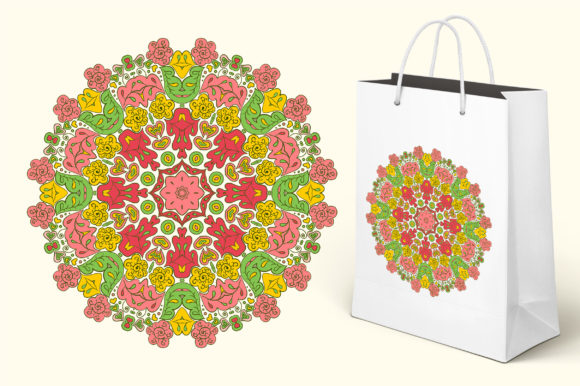
Floral Lace Motifs. Mandala Graphics & Illustrations
A Brand Designer’s Real-World Review for Local Business Use
As a brand designer who’s developed visual identities for over 30 local businesses—from artisanal candle studios and neighborhood bakeries to organic skincare makers and seasonal gift boutiques—I approached Floral Lace Motifs. Mandala not as clipart, but as a potential cornerstone graphic design asset for small business branding. My first impression? It evokes quiet elegance—delicate yet intentional, handmade without feeling amateurish, ornamental without overwhelming. The interplay of botanical rhythm and mandala symmetry suggests organic authenticity, gentle femininity, and mindful craftsmanship. It reads as premium but approachable—ideal for brands that value tactile warmth: think lavender soap labels, heirloom coffee packaging, boutique stationery, or floral studio thank-you cards.
Where This Asset Earns Its Place in Real Local Business Projects
Floral Lace Motifs. Mandala shines where personality meets practicality. For a handmade soap business launching a spring collection, I used it as a subtle border on product labels—scaled down to 8mm height—creating instant visual hierarchy between scent name and ingredients. On a bakery’s reusable cotton bag, the motif became a tonal watermark behind the logo, reinforcing brand identity without competing with the bold serif logotype. In a florist’s seasonal campaign, it anchored Instagram carousel graphics: one motif centered on a muted sage background, paired with clean sans-serif text—elevating social media graphics from generic to gallery-worthy.
It works exceptionally well for:
- Product labels—as a frame, corner accent, or repeating pattern behind minimal typography
- Packaging design—embossed foil accents on kraft boxes or soft-printed liners for gift sets
- Thank-you cards & hang tags—adding tactile sophistication to unboxing moments
- Menu graphics & price lists—introducing rhythm and pause in otherwise dense layouts
- Seasonal campaign visuals—reinforcing themes like renewal (spring), harvest (fall), or stillness (winter)
- Printable design inserts—for subscription boxes, retail bags, or workshop kits
How It Strengthens Small Business Branding—Beyond Aesthetics
This isn’t just decoration—it’s functional brand architecture. When applied thoughtfully, Floral Lace Motifs. Mandala delivers measurable business value: a stronger first impression at farmers’ markets or boutique shelves; improved product recognition across digital and physical touchpoints; clearer visual hierarchy on crowded packaging; more consistent brand identity across stickers, posters, and web banners; and—critically—a more polished, trustworthy presentation that signals care and intentionality to customers.
I’ve seen local food brands gain shelf appeal simply by replacing generic stock borders with this motif on jar labels. A children’s toy shop used it as a subtle watermark on receipt tape and loyalty cards—creating continuity no customer consciously noticed, yet subconsciously associated with warmth and attention to detail.
Where to Use It With Intention—And Where to Pause
This asset excels in decorative, atmospheric roles—not functional ones. It performs best as a supporting element: a hero graphic behind a headline, an elegant divider between sections on a website banner, a refined accent on a business card’s back, or a delicate repeat pattern on tissue paper.
Use carefully—or avoid—in these contexts:
- Formal corporate branding: Its organic flow clashes with rigid legal or financial services identities.
- Very small labels (under 12mm height): Fine lace details blur or vanish in print or on curved surfaces like lip balm tubes.
- Crowded packaging: When ingredient lists, certifications, or regulatory text dominate, the motif competes rather than complements.
- Luxury minimalist brands: If your aesthetic is monochrome, high-contrast, and reductive, this adds visual weight you may not want.
- Low-contrast backgrounds: Light motifs on cream or oatmeal substrates risk disappearing unless tested in real print conditions.
Practical Brand Designer Notes Before You Implement
Before locking Floral Lace Motifs. Mandala into your brand system, run these checks:
- Test on real packaging mockups—not just digital previews—especially on textured papers or curved containers.
- Check black-and-white usage: Does the motif retain legibility and balance when stripped of color?
- Preview at actual label sizes: Zoom in at 200% to assess fine-line integrity in PNG or SVG exports.
- Test with your brand colors: Does it harmonize with your primary palette—or create unintended contrast or vibration?
- Compare against competitor packaging: Does it differentiate your offering, or unintentionally echo another local brand?
- Verify print quality: Request a physical proof if ordering bulk runs—halftone rendering can soften lace edges.
- Review transparency handling: Confirm PNG files have clean alpha channels for seamless layering in Canva templates or editorial design workflows.
- Inspect vector editability: If you need to recolor or scale infinitely, confirm the SVG design is layered and path-based—not rasterized.
- Test typography pairings: Try it beside serif (e.g., Playfair Display), sans serif (e.g., Inter), script (e.g., Pacifico), handwritten (e.g., Qwigley), and display fonts (e.g., Bricolage Grotesque) to gauge harmony.
- Confirm commercial licensing: Ensure your use—whether for client work, physical product sales, or social media graphics—falls within the license scope. Never assume marketplace terms cover resale or trademarked branding.
At its core, Floral Lace Motifs. Mandala is more than a digital product—it’s a tool for storytelling. When aligned with authentic brand voice and applied with restraint, it helps local businesses signal care, craft, and connection. Not through loud statements, but through quiet, considered detail—the kind customers remember when they reach for your soap, sip from your mug, or tuck your thank-you card into their journal.